Testing on Healthy People
Remedies are tested on healthy volunteers to observe and record the symptoms they produce.

10 April 1755 - 2 July 1843
Christian Friedrich Samuel Hahnemann was a physician, chemist, linguist, and tireless investigator who devoted his life to developing a gentler and more systematic approach to healing.
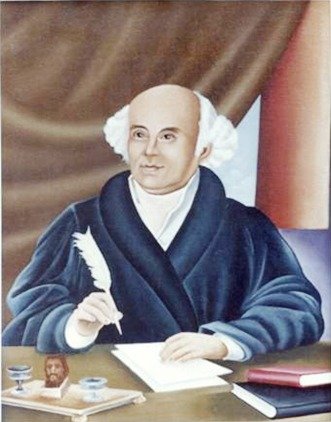
"In my lifetime I deserve no recognition for the beneficent truth which I have unselfishly propagated. What I have done for the world I have done from higher motives."
Dr. Samuel Hahnemann
Christian Friedrich Samuel Hahnemann was born in Meissen, Saxony, to Christian Gottfried Hahnemann, a painter, and Johanna Christiana Spiess. Although his family had limited means, his ability and determination enabled him to pursue higher studies. He studied medicine at Leipzig and continued his clinical education before receiving his medical degree in 1779.
Gifted in languages and chemistry, he supported his family through scientific writing and translation. His close study of medical literature, together with dissatisfaction with the harsh treatments then in common use, led him to suspend conventional practice and search for a more dependable law of cure.
While translating a medical work in 1790, Hahnemann questioned the accepted explanation for cinchona bark's use in intermittent fever. He tested the substance on himself and observed a pattern of symptoms resembling the illness it was used to treat. Further experiments led him to formulate the principle similia similibus curentur - let like be treated by like.
He presented the principle publicly in 1796, establishing the starting point for the clinical method explained in the sections that follow.


“Let likes be cured by likes.”
Similia similibus curentur is the central principle of homoeopathy. In classical homoeopathic theory, a remedy is selected when its recorded symptom picture closely resembles the patient’s symptom picture.
Hahnemann contrasted this approach with contraria contrariis, the historical idea that opposites are treated by opposites.
Remedies are tested on healthy volunteers to observe and record the symptoms they produce.
A patient is given a small dose of the remedy whose known symptom picture most closely matches the individual case.
The small dose is intended, within homoeopathic theory, to stimulate the body's natural healing response.
Hahnemann’s teaching emphasises three cautions for the homoeopathic physician.
Do not assume that a correctly selected remedy is ineffective merely because the dose is small.
Avoid indifference, the pursuit of convenience, or pride that leads to disregard for the complete symptom picture.
Do not interrupt a remedy before it has had adequate time to complete its action.
He tested medicinal substances on himself and willing healthy participants, recording the symptoms they produced.
His investigations included substances derived from plants, minerals, animal sources, and chemical preparations.
Changes in body and mind were documented carefully and compared with the complete symptom picture of the patient.
He refined methods of preparation and dosage while seeking effective treatment with the least possible medicinal intervention.
Beginning in 1811, his collected observations were published as a foundational record of remedy pictures.
He repeatedly reviewed his conclusions in the light of experience and revised his writings throughout his life.


The Organon of Medicine is Hahnemann’s central exposition of homoeopathic principles, clinical observation, remedy selection, and the physician’s duty.
First published in 1828, The Chronic Diseases presented his later inquiry into persistent disease and chronic miasms.
Historical accounts portray Hahnemann as exacting, self-reliant, and devoted to the care of the sick. He insisted on earnest case-taking, freedom from prejudice, patient observation, and enough time for a correctly selected remedy to act. He warned against careless prescribing, unnecessary repetition and the indiscriminate mixing of different medical methods.
His guidance also considered food, habits and the conditions of daily life, especially in chronic illness. The physician, in his view, needed knowledge, moral courage, compassion and an untiring commitment to truth.
He advised identifying dietary, environmental and habitual influences that might obstruct treatment, while adapting guidance to the individual case. These historical directions belong within qualified clinical judgment and should not replace necessary medical care.


Hahnemann taught that the physician should understand the patient's complete symptom picture and select the remedy whose known picture most closely resembles it.
Collected symptoms are organised and evaluated according to their individual character and clinical importance.
The method calls for a single, carefully selected remedy at a defined potency.
Hahnemann opposed giving two remedies simultaneously. His method calls for observing the action of the selected remedy and repeating or changing it only when the evolving symptom picture justifies that decision.
A dose should be allowed sufficient time to act according to the patient's condition and response. Hasty repetition, frequent changes, or intervening remedies may make the case more difficult to interpret.
In Hahnemann’s theory, a stronger similar disease state could permanently displace a weaker one, while a stronger dissimilar state might only suspend the weaker state temporarily. Remedy selection therefore follows the symptom totality present at the time of examination.
Born at Meissen in Saxony.
Received his medical degree.
Conducted the celebrated experiment with cinchona bark.
Published the principle that marked the beginning of homoeopathy.
Began publishing Materia Medica Pura.
Published the first edition of The Chronic Diseases.
Passed away in Paris on 2 July 1843.
"On my honour, I swear that I shall practise the teachings of homoeopathy, perform my duty, render justice to my patients, and help the sick whoever comes to me for treatment. May I have the strength for fulfilment of my mission."
A guiding pledge for every homoeopathic physician
Hahnemann's life joined intellectual courage with sustained service. He gave up a successful conventional practice, tested his ideas on himself and through sustained observation, and spent decades refining a system intended to alleviate suffering. His writings continue to be studied by homoeopathic physicians and students throughout the world.
"God owes me nothing, but I owe God much."
Careful experiment guided by observation.
A lifelong search for a gentler approach to healing.
Principles preserved in foundational works.